
Breaking news this week from Mount Shasta, California: not about its volcano erupting, nor about saloon shoot-ups , anti-vax protests, or the secessionist State of Jefferson. Certainly nothing to do with the presidential debate tonight, though Trump signs adorn front yards and alfalfa fields throughout the county.
The big news is that Governor Newsom is returning 2,800 acres of land to the Shasta Tribe.
Never mind that the Shasta Tribe is not federally recognized, nor that only 250-300 tribe members appear to have survived the serial catastrophes of the American occupation.
In 1851 California’s first governor, Peter Burnett, announced that “war should be expected until the Indian race is extinct.” Bounties were paid: in 1852, between 73 and 200 Indians were killed by the Siskiyou Volunteer Rangers, for $14,987. In 1854, in the Shasta Expedition, 58-63 Indians were killed for $4,068.
The Native American population in California drastically declined from around 150,000 in 1848 to fewer than 30,000 by 1870, 16,000 in 1900. As acknowledged by California’s present governor, this was nothing less than genocide.
For those natives who survived the slaughter, the California Oregon Power Company decided to dam the Klamath River to create more electric power for the growing settlements downstream. These dams, completed in 1918 and 1925, resulted in the flooding of Shasta villages, ceremonial sites, and fertile farmland. The salmon runs, vital for the subsistence of the Shasta people, were blocked.
More News from the Wild West: this very weekend in Siskiyou County, some of my farflung family are gathering in the campground below the Smith-Van Ness property on Scott Mountain. These are dispossessed cousins, as am I, who meet every year, usually around July 4. I recounted the following chapter of family history a few years ago, shamelessly highlighting the gold mine and the bordello. Now that I think of it, this was just before Trump’s election in 2016.
Around the start of the last century, my grandfather and his cousin found gold on a slope an hour west of Mount Shasta, as the crow flies. They lost no time homesteading a hundred forested acres around their mining claim.

Not much gold emerged after that initial strike on Scott Mountain. No matter: each summer several families of Smiths and Van Nesses trekked some three hundred miles from San Francisco and Oakland to camp out while they worked the mine and fished the high lakes of Trinity and Siskiyou counties. Eventually they built cabins. According to my father, the boys used serial pints of firewater to induce “Indian John,” to do most of the heavy work.

My grandmother Anne and Grace Van Ness were best friends, small, sharp-tongued matriarchs dressed in no-nonsense jeans and gingham shirts, who kept their children, grandchildren and–to a lesser degree their husbands–in some kind of order. They went together to provision the camps in the little valley towns of Callahan and Etna. Most mornings there were sourdough pancakes on the wood stove, and most nights there was a lot of drinking and a campfire with marshmallows and tallish tales.
The families eventually ramified into two camps, with cabins separated only by a few hundred yards of creek and boulders. In time, notably after one Van Ness girl jilted one Smith boy, the families began to pull apart. The Van Nesses, although they generally had more money at hand than the Smiths, decided to sell off part of their half to lumber interests.
After the death of Granna Anne, the Smiths had their own problems. One cousin took over the mountain camp and let it be known that she had no use for professors like my husband, who had also been known to go fishing with a Van Ness elder.
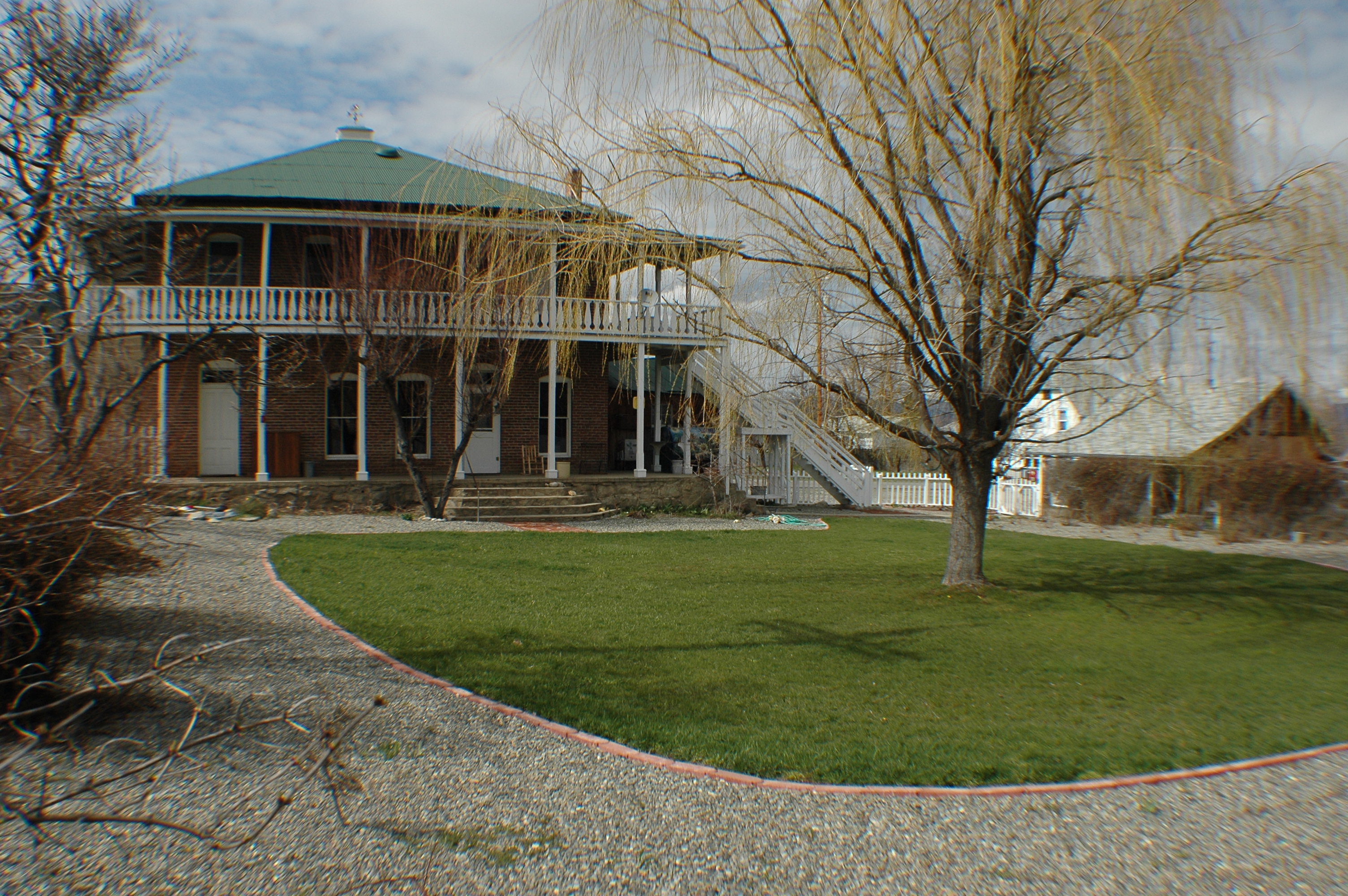
After some ten years of summer exile, our enterprising son (also a professor, studying Californian & Peruvian Indians ) decided to rent a small hotel in the Scott Valley, where our branch of the family could gather and make forays to the familiar lakes and swimming holes around Scott Mountain. The Collier Hotel in the town of Etna, with six bedrooms and several common rooms, served our needs perfectly.
We all assumed that our gracious inn was the former home of the late Randolph Collier, a California state senator known as the Silver Fox of the Siskiyous. A strapping fellow with a thatch of white hair, he had been able to secure regular servings from the state pork barrel for his home county. He never saw a local bridge that didn’t need re-building, and the Collier-Burns Act of 1947 financed a surge of highway building that made California’s freeways famous for a time. (Note: my father, seeing the main chance to support his family after the war, became a highway engineer, although he had always disliked cars and driving.)
Just now, in the course of my usual desultory research, I learned that the Collier Hotel, with its gracious southern-style verandah, had been purpose-built in 1897 as a brothel. I’m supposing that the rest of the family may think this is rather jolly. Some of us grew up with Westerns where the heroine was Miss Kitty, the local madam with a heart of gold, or someone very like her.
The Collier Hotel’s latest hosts are a lovely woman, born a Karuk Indian, and her amiable husband, a Desert Storm vet. The Karuk, Klamath, and Shasta tribes are survivors. Countless Indians died in the western takeover of the Scott Valley. Though there were no Catholic missions in the north, perhaps the number who died of disease and settlers’ bullets there equaled those who died under the Christian fathers in the south of the state. (Children in California public schools still study the missions, but they do have more information than we did in the 1950s.)
Etna, an old ranch town in the Scott River valley, pop. 737 (down 50 from last census) has a barbershop, an excellent hardware store and a small supermarket. You might see a cow or more likely a deer wandering down Main Street. A flock of bats issues forth at twilight from the garret of the abandoned masonic hall. For a while there was a fine little Vietnamese restaurant in town, but the locals never warmed to it, and the family moved on. I didn’t need to ask: Trump is undoubtedly the local choice. Etna has no newspaper now, but in 1900 there were two, feuding of course. One editor called the other “a pin-headed cur”. No wonder people miss their local papers.

 frances smith starn
Thanks Francie. Quite a family story… the ‘old’ wild West was as uncivilized as it is today.
LikeLiked by 1 person
[…] Jed Harris on More News from the Wild W… […]
LikeLike
Great to see another installment of your friendly thoughts!
LikeLiked by 1 person
A rich history embroidered with dreadful and delightful twists and turns, beautifully described.
LikeLiked by 1 person
I loved every sentence for its own sake. And more generally—you take a tone for our times! Keep it wry, and keep it coming! Brava! Rachel
LikeLiked by 1 person
Loved it, thanks.
LikeLike
Good to hear from a Smith!
LikeLike
Miss Kitty went upstairs with Marshal Matt Dillon in the radio version of Gunsmoke but she was cleaned up for the TV version; she became a “gambler.”
LikeLike
I never heard the radio version (too young,I guess 😉 but can’t quite imagine the audio suggestion that they “went upstairs.”
LikeLike