Home » Posts tagged 'people’s park'
Tag Archives: people’s park

People’s Park UPDATE, Berkeley, July 2025
In Berkeley, at Harvard, Columbia—any American universities whose administrations are not brain-dead—everyone fears Trump’s next move. Among his thwarted peacemaking efforts and his tariff games, he will do what he can to destroy an educational elite who questions his MAGA pretensions.
Two years ago, I checked occasionally on the encampment in People’s Park just a block and a half from my house. A smoky haze almost hid the new red tent that appeared that morning, and the university campanile and its celebrity falcons were obscured behind the scrubby trees. Upwards of twenty tents were scattered through the park.
Fifty years ago, two blocks of old houses like mine were demolished for student dorms that were never built. In time the space became a parking lot, morphing into People’s Park, a famous forum for antiwar protests, drugs, and what remained of Sixties counterculture. Over time the park devolved into a homeless camp, whose few inhabitants had little energy for coherent political rebellion.
Tent camps are both the oldest and the latest response to California’s housing crisis. Gavin Newsom’s optimistic program, Project Roomkey, placing vulnerable unhoused in vacant hotels and motels, was only tenable with federal support. What seem to be working, still and again, are these tent communities, whether scattered and scruffy or–not often–in neat grids, with services. Homelessness in this affluent society is hardly a new phenomenon. What is new is the emergence of these encampments in city centers and at highway intersections, where their high visibility and persistence painfully signal, any way you look at it, a broken social contract.
The founding myth of the University of California describes eminent clergy shading their eyes as they gaze across the bay, quoting Bishop Berkeley: “Westward the course of empire….” More recently, the University has been described as a group of entrepreneurs seeking a parking place.
In 1868, joking aside, the location of the new university campus vastly inflated the property values of four local investors. Francis Shattuck, William Hillegass, and their partners had divided a square mile of land just south of the projected campus, for which they had paid about $31 per acre. The loser in this deal was ultimately the holder of the Mexican land grant, Jose Domingo Peralta–not counting the few surviving natives, whose history is piously noted in historical plaques and
Francis Shattuck’s eventual heir was philanthropist Weston Havens, a childhood friend of the maiden lady who sold us her family home. When we moved in, he gifted us with sacks of fertilizer meant to sustain the viciously rampant Silver Moon rose over the driveway trellis. He wanted to soften the view of the four-story apartment building south of us.
Meanwhile, our clapboard manse on Hillegass was continuing to increase in value as the Bay Area economy boomed. A century past the Gold Rush, there was the pulsating prosperity of Silicon Valley and its garage geniuses. And in California, especially, the rich grew richer, billion by billion, and the poor poorer, year by year, decade after decade.
As Henry George, 19th-century economist and social reformer, observed: . . . the tendency of what we call material progress is in nowise to improve the condition of the lowest class in the essentials of healthy, happy human life. George saw the root cause of inequality as wealth increasing through unearned land value, whether near the new transnational railroad lines or next to the projected campus of what would soon become the world’s top public university. Henry George’s solution, a single tax on land value, soon proved flawed, since land’s value also depends on its potential and its improvements. In 1880 George left the west coast to try out his progressive ideas in New York City. In the mayoral race, he finished well ahead of Republican Theodore Roosevelt, but lost narrowly to a Democratic candidate whose name I and many others have forgotten. * *
Real estate profiteering, hard to regulate, remains a prime cause of homelessness. A group of homeless mothers in Oakland, California recently defeated eviction efforts by a major speculator and gave a boost to community land trusts
* *
While property tax remains the main source of funding public services. California voters have repeatedly rejected any tax increases, even on the fattest commercial and industrial property. As the state budget shrinks support for public schools and colleges, the University of California, already short of housing, raises tuition costs and expands enrollment to fund its programs. And builds on a historic site of protests against our misguided wars.
Hotels in Times of Trouble

Not the Majestic Hotel, but very like
Trouble at the Majestic
The year is 1919, the scene a decaying imperial spa in County Cork, Ireland. The owner of the Majestic Hotel is an Anglo-Irish aristocrat who cares more for his dogs and piglets than for the starved villagers who raid his potato patch by night. His beloved piglets are housed in the former squash court and fed yesterday’s pastries.
The Majestic Hotel figures in Trouble, a tragicomedy about the Irish rebellion against British rule–performed against a background of guerrilla attacks by the rebels and vicious reprisals by the British. The “Troubles” exploded again in 1970, the year that J.G.Farrell’s remarkable novel appeared.
PROJECT ROOMKEY
A century after the partitioning of Ireland, amid the planetary chaos of the coronavirus pandemic, California’s vacant hotels suddenly figure in a social and economic crisis of survival.
California governor Gavin Newsom, confronting the vulnerable and potentially infectious mass of 150,000 homeless in the state, has engineered an ingenious deal. Hotels and motels, most notably Motel Six, have made available for lease some 15,000 hotel rooms for housing the most fragile homeless–the aged and those with underlying health conditions.

Newsom announced Project Roomkey at a press conference in front of a Motel Six in Campbell,California. Campbell is an unremarkable Santa Clara Valley town where I went to high school, when prune orchards were just giving way to housing tracts, highways, and the garage startups that transformed the farmland suburbs into Silicon Valley.

Looking west over Silicon Valley
In the early days, Campbell, California had at least one street of “affordable housing,” inhabited by poor people, then generically called “Okies”. Gilman Avenue was a few blocks of small greyish bungalows, some with junked cars as lawn furniture. Betty the Moocher lived on Gilman. She was pallid and grimy with a plaintive, small-featured face. During lunch hour she would stand nearby, gazing silently at your sandwich. Sometimes we would give her something. It never occurred to me that she could actually have been hungry, though there were no free lunch programs then.
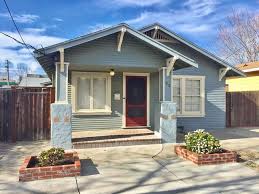 One of those Gilman bungalows is for sale right now as a “vintage” fixer-upper, for $1,220,000. Down half a million from its earlier listing. Most people cannot now afford any sort of home in California, but there are more free lunch programs. Just no housing.
Given the continuing pandemic lockdown, Project Roomkey hotel rooms would have been vacant anyway–a seemingly perfect solution, with FEMA ready to pay 75% of the costs. But two weeks ago only some 4,000 of the 15K available rooms were occupied. Tidy charts showed how many rooms had been leased for the project, how many were being prepared for occupancy, and the relatively few which were actually occupied.
It is not a simple process. The first challenge is the vetting of would-be occupants, by experienced social workers already overstretched by the Covid crisis. Applicants range from the responsible but roofless and medically fragile to lifelong addicts who may trash their rooms if not regularly supplied with their drugs. Medical records and background checks are needed. Staffing has to be arranged to provide food, housecleaning, medical help–and security.
Several counties have already signed onto Project Roomkey. But a number of southern California townships have rejected any use of their local hotels as homeless housing, either temporary or permanent. And anecdotal reports from some of the occupied lodgings are not good. Social distancing, along with housekeeping and private property, are unfamiliar concepts for many formerly homeless folks.
California has the fifth largest economy in the world, one of the highest costs of living in this country, and the largest number of homeless of any state. Some see this as flagrant evidence of a failed government–the inability to provide for the welfare of its least able citizens. Newsom, as governor, and earlier as mayor of San Francisco, took on homelessness as his central issue. There was the controversial Care Not Cash, which reduced cash support and increased shelter and social services. Now there is Project Roomkey.
Here in my present hometown of Berkeley, 40 homeless have moved into two Oakland hotels that are part of Project Roomkey. Each room is $186 per day, to be 75% reimbursed by FEMA. For whatever reason, Berkeley jokes aside, these are not Motel Six rooms like those claimed by other counties, which normally rent for $76 per night. Meanwhile the proposal for 16 stories of housing to be built at People’s Park brings out opponents pointing to its 50-year history as a political symbol and a refuge for the homeless.
Newsom and his allies would like to see Project Roomkey succeed and extend beyond the pandemic. This cannot happen without aligning funds from state, local, and federal sources. And so far, even money has not proven to be the answer. Homelessness was a serious problem in California long before COVID-19, and will doubtless increase afterwards, given the economic devastation of the work stoppage as well as earlier problems with local zoning and construction workers’ unions.
Bond issues for building affordable housing have been passed and then failed dismally to address the need. In California it costs $450K to construct one no-frills unit of subsidized low-cost housing. This is based on rising costs of labor and material and the expensive delays between securing funding and local approval of the project and the site. Given the cost of new construction, adapting ready-made housing seems a rational solution to the very immediate needs of California’s 150K homeless.
Some say that this apparent emergency will shrink back into perspective once our society returns to normal. Others point out that “normal” has included indifference not just to homeless encampments under our clogged freeways, but to the climate crisis, to enormous income inequality, to mass shootings, and to the continuing partitioning of our electorate that gave us Donald Trump. ∞
 frances smith starn